
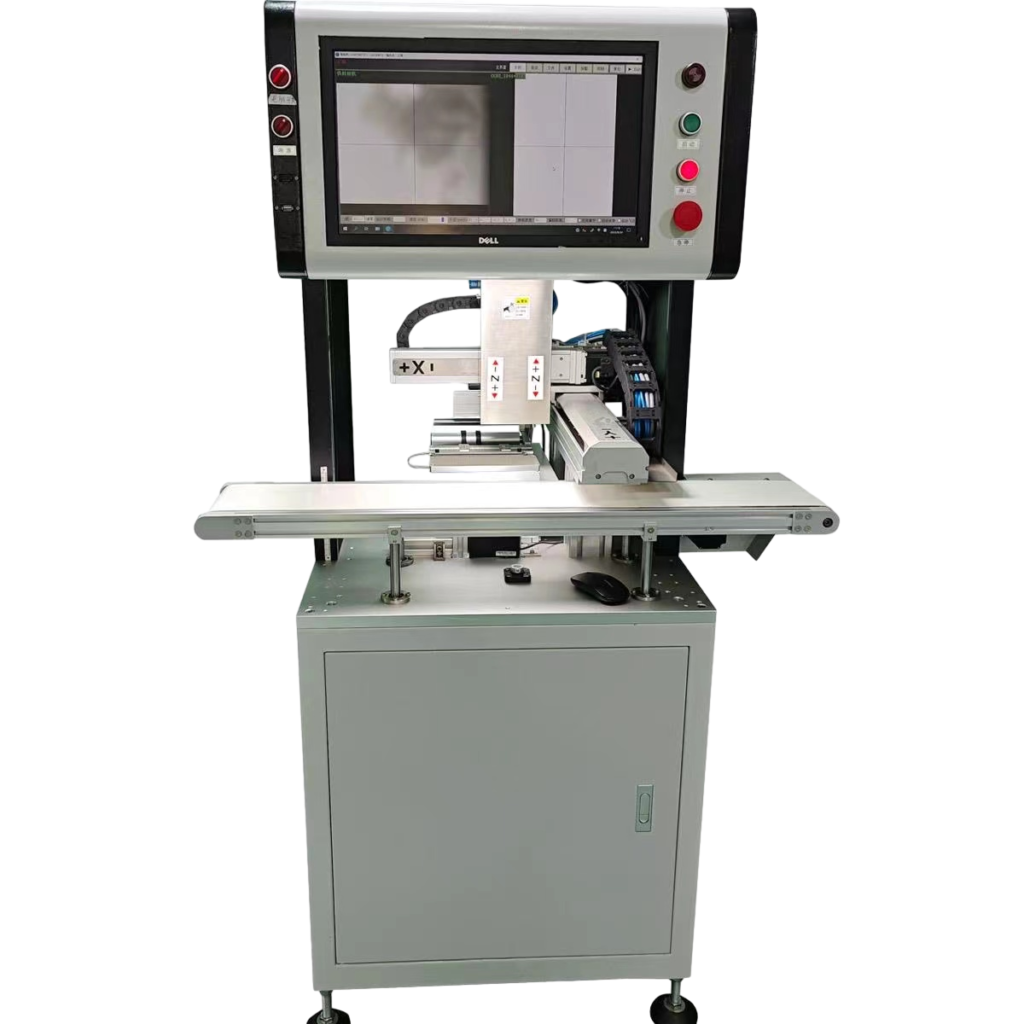
Direct product answer
What is a CCD vision labeling machine?
A CCD vision labeling machine uses an industrial camera to identify a product’s actual position and orientation before label application. The vision software calculates the offset, and a servo positioning mechanism moves the product or labeling point to the required coordinates.
This approach supports products that enter with inconsistent spacing, angle or orientation. It is particularly useful when conventional guides cannot position every workpiece accurately enough for the required label location.
Product overview
Camera-guided positioning before every label application.
The CCD vision labeling machine combines product feeding, image recognition, coordinate calculation, servo positioning and automatic label application in one controlled process.
CCD product recognition
The camera identifies the product outline, reference feature, position and rotation angle within the configured field of view.
Vision coordinate correction
The software compares the detected position with the approved labeling coordinates and calculates the required movement.
Servo-controlled positioning
A controlled motion mechanism corrects the workpiece or application point before the label is transferred.
Recipe-based changeover
Product recipes can store approved recognition and placement settings for compatible formats.
Operating workflow
How the CCD vision positioning process works.
The exact feeding and motion structure depends on the product, required cycle time and available reference features.
Product feeding
A feeder, tray, conveyor or manual loading station presents the product to the vision area.
Image capture
Controlled lighting and an industrial camera capture the product image within the inspection field.
Position calculation
The vision software finds the approved reference feature and calculates the X, Y and rotational offset.
Servo correction
The motion system corrects the product position or moves the labeling mechanism to the calculated coordinates.
Label application
The machine dispenses and presses the self-adhesive label onto the defined surface.
Discharge or optional inspection
The finished product exits for collection, downstream processing or an optional post-label inspection.
Typical applications
Designed for flat, irregular and randomly oriented products.
Final suitability depends on surface condition, reference-feature visibility, label dimensions, positioning tolerance and feeding stability.
Circuit boards, modules and flat electronic assemblies.
Covers, shells and molded parts with visible reference features.
Metal plates, panels and machined flat components.
Compatible cells, packs and flat battery components.
Identification cards, nameplates and flat information products.
Stable pouches or bags presented within a controlled labeling area.
Compact products that require camera-guided placement.
Irregular products evaluated through sample testing.
Identification labels that require controlled placement.
Reference specifications
Current reference configuration.
These values describe a reference machine configuration. Confirm every parameter in the final quotation after product and label testing.
Optional functions
Configure the machine around the complete process.
Optional equipment should be selected only after the product range, label specification and required acceptance criteria are confirmed.
Custom automatic feeding
Tray, paging, conveyor or custom feeding can be evaluated according to product shape and handling risk.
Online variable-data printing
Add barcodes, QR codes, dates, batches or serial data before label application.
Post-label visual inspection
A second inspection step can check defined conditions such as label presence, position or readable data.
Automatic rejection
Remove products that fail approved inspection rules when the application supports reliable separation.
Multiple labeling heads
Evaluate more than one labeling head when a product requires multiple labels or positions.
Production-line integration
Exchange start, stop, ready and fault signals with compatible upstream and downstream equipment.
Technical distinction
Vision positioning and label inspection perform different jobs.
Define both requirements separately so the quotation includes the correct camera, lighting, software and rejection functions.
| Function | When it occurs | Primary purpose | Typical result |
|---|---|---|---|
| CCD vision positioning | Before labeling | Find the product position and orientation | Correct the application coordinates |
| Label application | After coordinate correction | Transfer the label to the defined surface | Apply the label at the target position |
| Optional visual inspection | After labeling | Check approved label or print conditions | Pass, alarm, stop or reject |
Project preparation
Information required before machine configuration.
Complete project data helps determine camera resolution, field of view, lighting, motion range, label head and feeding structure.
Product samples
Provide normal products, difficult samples and known production variation.
Product dimensions
Confirm minimum and maximum size, material, weight and surface condition.
Reference feature
Mark the edge, hole, shape, print or feature that the vision system should detect.
Label specification
Provide label size, material, roll direction, liner width and actual production rolls.
Placement drawing
Show the required label position, reference point and allowable variation.
Production target
State normal output, peak output, batch size and expected changeover frequency.
Feeding method
Explain whether products arrive manually, in trays, randomly or from upstream equipment.
Inspection requirements
Define every required check, pass/fail rule and rejection response.
Factory conditions
Confirm available space, voltage, air supply, language and destination market.
Product FAQ
CCD vision labeling machine questions.
Final answers require actual product images, samples, label rolls and clearly defined acceptance criteria.
What is the main advantage of CCD vision positioning?
The system can calculate product position and rotation before labeling. This reduces dependence on purely mechanical alignment when products arrive with controlled but inconsistent orientation.
Can the machine label randomly oriented products?
It can evaluate products within the approved camera field and motion range. However, overlap, severe tilt, hidden reference features or unstable feeding may require additional handling.
What products can the camera recognize?
Recognition depends on visible edges, shapes, holes, printed marks or other stable features. Product contrast, lighting and surface reflection also affect feasibility.
Can the system inspect the label after application?
Yes, an optional post-label inspection can be evaluated. The inspection requirement must define the defect, tolerance, camera view and machine response.
Can barcodes and QR codes be printed online?
An optional printer and data system can add variable information before application. Confirm the data source, label material, print resolution and required cycle time.
What determines actual labeling accuracy?
Accuracy depends on image resolution, field of view, reference-feature quality, motion repeatability, label dispensing, product flatness and the measurement method.
Can the feeding system be customized?
Yes. Feeding can be evaluated for trays, stacks, conveyors or custom product presentation. Actual samples are required to confirm reliable handling.
What should be tested before purchase?
Test the complete product range, difficult samples, actual label rolls, normal and peak output, changeovers, fault recovery and all agreed inspection rules.
Request an application review
Send your product samples, label drawing and positioning requirement.
KEYUE-AUTO will evaluate the visible reference features, feeding method, camera field, motion structure and optional inspection requirements.